

Two founders in two different countries want the same thing: a small company in Singapore, set up properly by a firm they can rely on. One opens ChatGPT. The other opens Claude. They type the same question.
Both are likely to see Sleek and Osome recommended. Beyond those two, their shortlists part ways. On ChatGPT, the firm recommended most often to founders after Sleek and Osome was HeySara. On Claude, it was Rikvin.
Neither founder sees the other’s answer. Each assumes that what they read is what AI says.
Last week we published the first AI Visibility Index: which firms ChatGPT, Perplexity, Gemini and Claude recommend when buyers ask for help with Singapore corporate services. This edition looks at the same 324 answers from another angle. Not who was recommended overall, but how the four engines compare.
What we measured
We asked 27 questions a real buyer might ask, three times each, on each of the four engines. Eleven came from a foreign founder setting up a small company. Six came from an overseas company setting up a Singapore subsidiary, branch or regional company. Ten were information questions. The answers were collected through the engines’ APIs on 15 October 2026, with web search switched on. Every answer was classified against a written rule, and every recommendation is stored with the exact passage it rests on.
That gives 33 founder answers and 18 expansion answers on each engine. Those are the denominators below. Every figure counts how many answers recommended a firm, not where the firm appeared within an answer.
Where the four engines agree
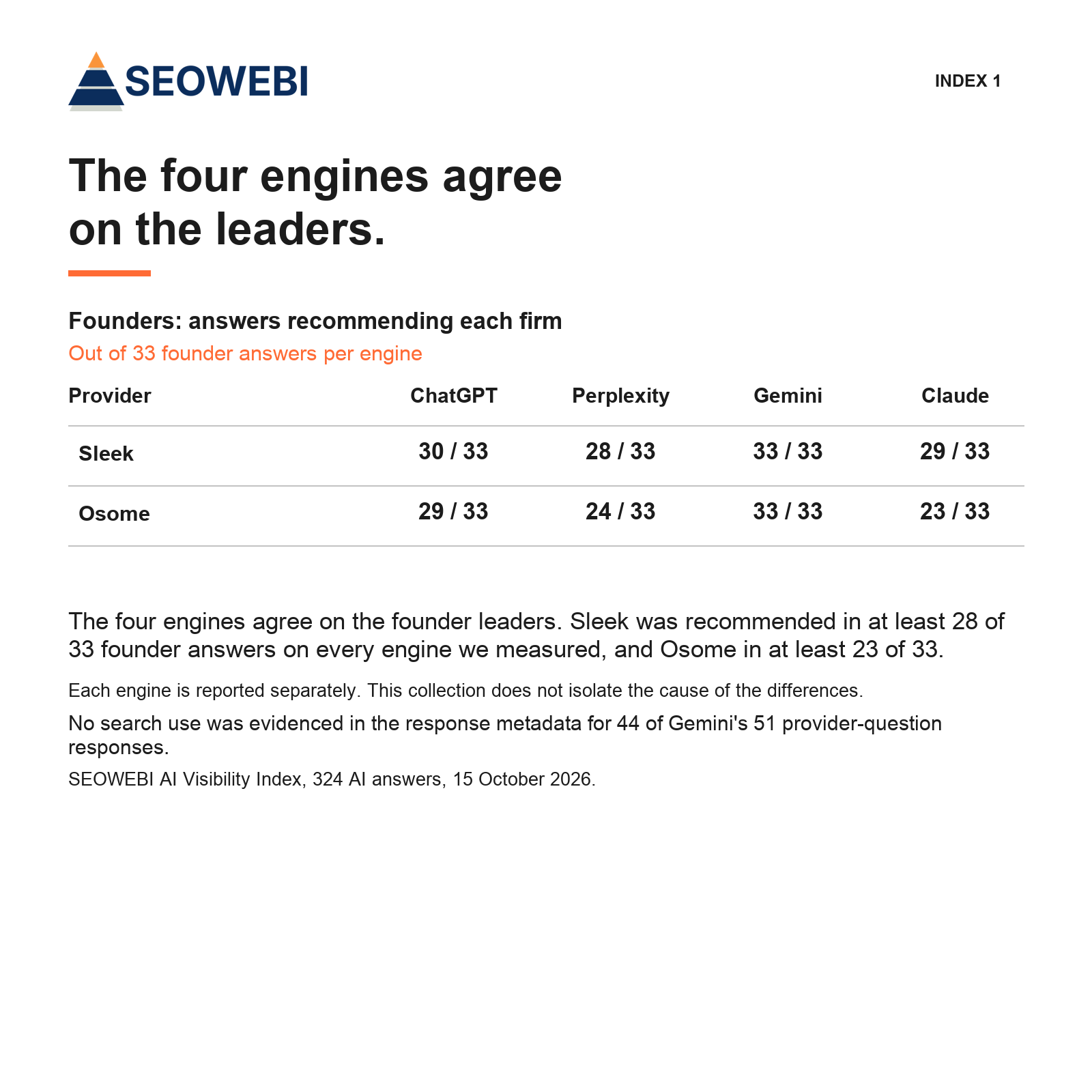
The four engines agree on the founder leaders. Sleek was recommended in at least 28 of 33 founder answers on every engine we measured, and Osome in at least 23 of 33.
The headline founder question shows it most clearly. We asked: “Which company would you recommend to help a foreign founder set up a small business in Singapore?” Each engine answered three times. Sleek was recommended in all three answers on every engine.
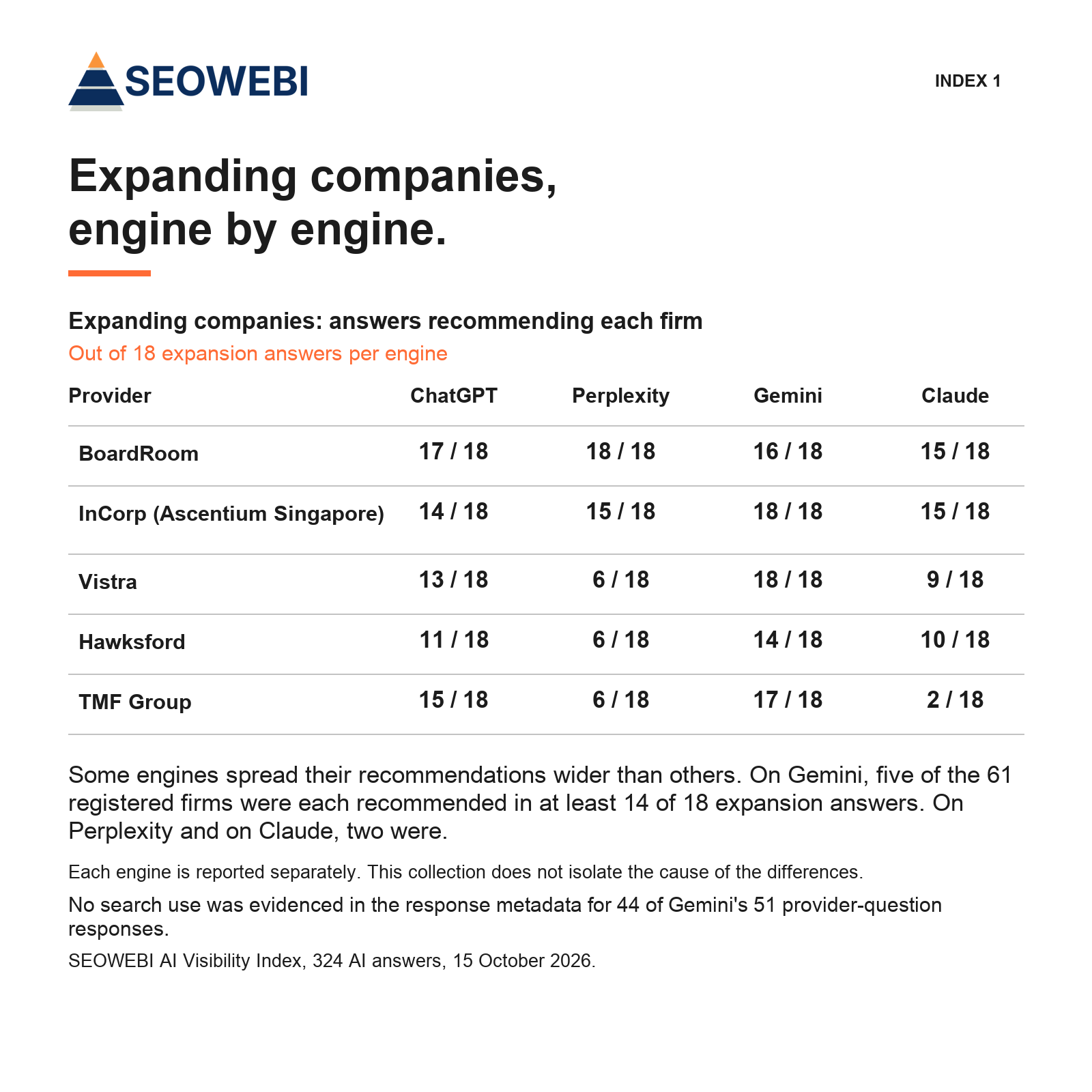
They agree on the expansion leaders too. BoardRoom was recommended in at least 15 of 18 expansion answers on every engine, and InCorp, now trading as Ascentium Singapore, in at least 14 of 18.
No search use was evidenced in the response metadata for 44 of Gemini’s 51 provider-question responses.
The leaders also hold when the question is repeated. Across the founder and expansion questions, Sleek was recommended in all three runs for 46 of the 49 question and engine pairs where it was recommended at least once.
Look only at the leaders, and the four engines look like one.
Where they part ways
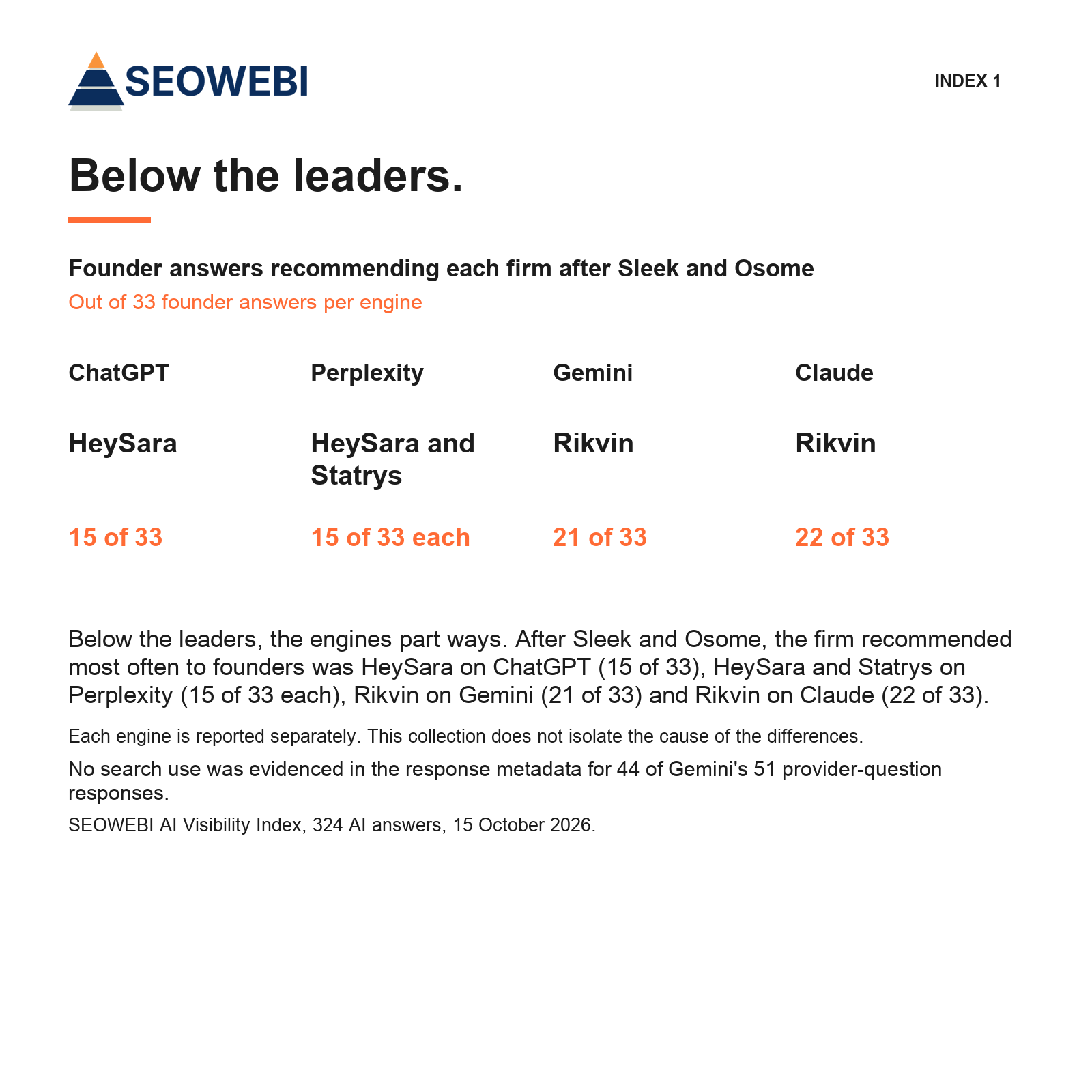
Below the leaders, the engines part ways. After Sleek and Osome, the firm recommended most often to founders was HeySara on ChatGPT (15 of 33), HeySara and Statrys on Perplexity (15 of 33 each), Rikvin on Gemini (21 of 33) and Rikvin on Claude (22 of 33).
Two firms show how large the difference can be. Rikvin was recommended in 22 of 33 founder answers on Claude and 21 of 33 on Gemini, but in 3 of 33 on ChatGPT. HeySara was recommended in 15 of 33 founder answers on ChatGPT and 15 of 33 on Perplexity, but in 2 of 33 on Gemini.
For a founder, whether those names appeared depended heavily on which engine they asked.
Each engine is reported separately. This collection does not isolate the cause of the differences. No search use was evidenced in the response metadata for 44 of Gemini’s 51 provider-question responses.
Expanding companies: the same pattern
The expansion answers follow the same shape. The leaders hold, and the firms below them move.
TMF Group was recommended in 17 of 18 expansion answers on Gemini and 15 of 18 on ChatGPT, but in 2 of 18 on Claude. Vistra was recommended in all 18 expansion answers on Gemini, and in 6 of 18 on Perplexity.
Some engines spread their recommendations wider than others. On Gemini, five of the 61 registered firms were each recommended in at least 14 of 18 expansion answers. On Perplexity and on Claude, two were.
Perplexity recommended Deloitte Singapore in 9 of 18 expansion answers and PwC Singapore in 8 of 18. No other engine recommended either firm in more than 4 of 18.
Each engine is reported separately. This collection does not isolate the cause of the differences. No search use was evidenced in the response metadata for 44 of Gemini’s 51 provider-question responses.
AI sorts firms by buyer
One more pattern appears in the founder answers. AI does not only name firms. It sorts them by buyer.
In founder answers, BoardRoom was recommended to the founder in 5 of 132, and recommended for a different buyer, such as a larger or more complex set-up, in 30 more. The same sorting applies to Hawksford: recommended to the founder in 13 of 132 founder answers, and for a different buyer in 29 more. And to InCorp (Ascentium Singapore): recommended to the founder in 31 of 132 founder answers, and for a different buyer in 34 more.
These firms were not left out of founder answers. The answers pointed them at someone else. Being recommended for a different buyer is not the same as being recommended to the buyer who asked.
What this does not tell us
We do not know why the engines differ. They could differ for several reasons, and this collection was not designed to separate them. No engine is the right one. Each is a door a real buyer uses.
A question for firms that sell in Singapore
If you have looked at one engine, you have seen one of four answers. Which AI does your buyer use?
One engine’s answer is not the market’s answer.
Next week
Edition 3 looks at what did not appear: the patterns among the registered firms that were not recommended in any answer, and the websites the answers cited most.
Get the full Index (10 pages, free): https://forms.seowebi.com/ai-visibility-index?edition=sg-corporate-services
If you want the same measurement for your own firm, the AI Brand Intelligence Report is here: https://www.seowebi.com/run-report
AI Visibility Index 1, Singapore corporate services. 324 answers from ChatGPT, Perplexity, Gemini and Claude, collected through their APIs on 15 October 2026. 27 buyer questions, each asked three times.